Tank-farm fence, night
PIDS segment 7 plus camera 12 confirms a person crossing within 5 seconds. High: floodlight, siren, patrol, record. PIDS-only: Low.
Standalone sensors cry wolf. Standalone video does too. A verified alarm is two independent signals that agree, mapped in space and time.
Fence PIDS and PIR trip on wind, rain, loose panels, animals and vegetation. The UK NPSA notes that PIDS are prone to false alarms, and that over-sensitive systems produce too many alarms to verify. Video analytics alone false-alarms on shadows, rain, insects on IR illuminators, headlight glare and moving foliage.
AND/OR logic. Temporal correlation windows. Spatial mapping of sensor zones to camera fields of view. Confidence from model score, sensor agreement, temporal and spatial match, and environmental context.
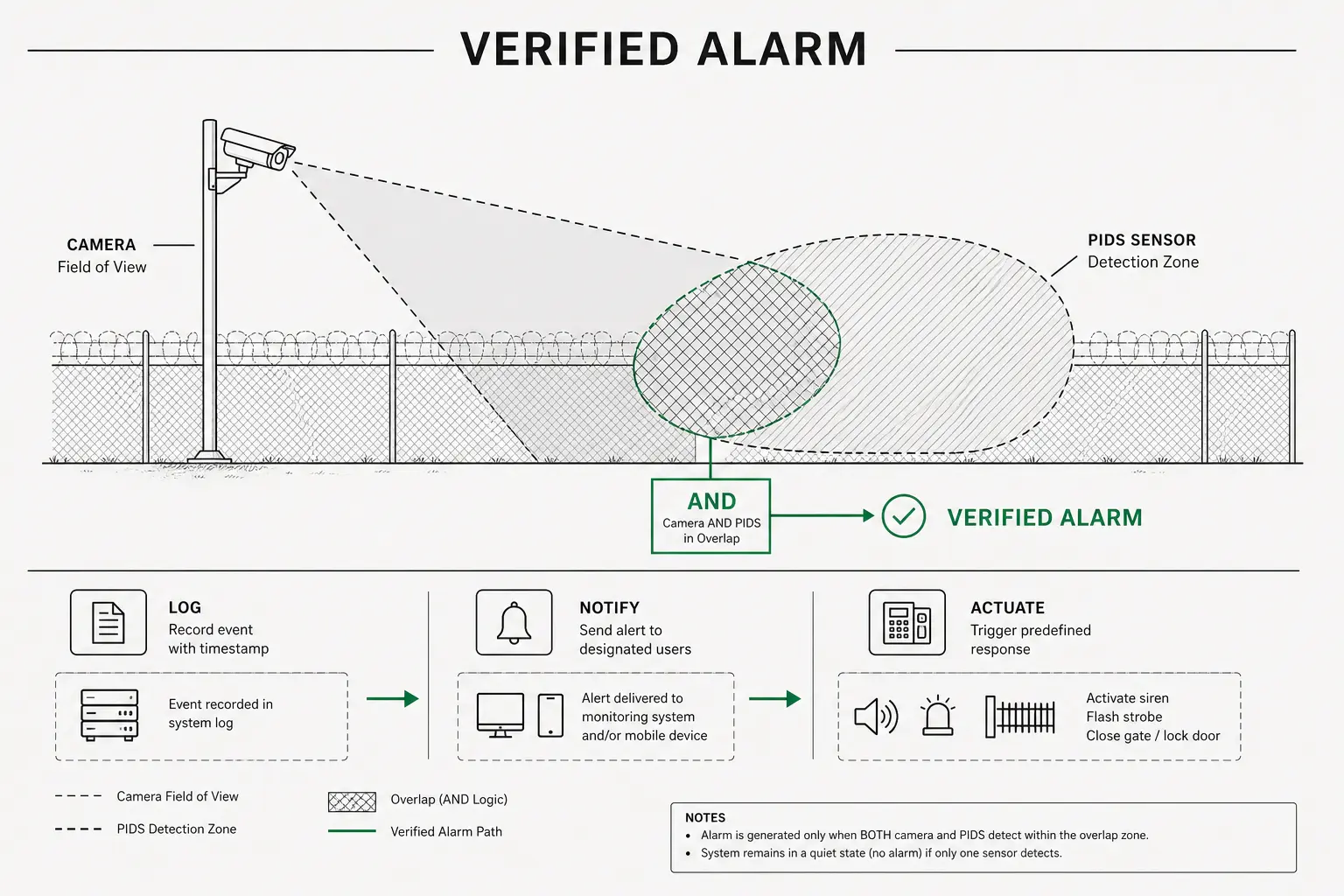
Securitas Technology reports traditional alarm monitoring produces a 98% false-alarm rate. Pelco/Calipsa and Lumana report that video verification cuts false alarms by up to 90%. Fusing verified video with a corroborating sensor pushes reliability further.
A verified alarm is at least two independent signals that agree. Only verified alarms are dispatched.
Low
Log. A single noisy signal stays in the record.
Medium
Notify. A supervisor or NOC sees it.
High
Actuate. Barrier, siren, PA, dispatch.
Optional human-review tier for irreversible actions. Customer-configurable. Off by default.
Protocols
LoRaWAN · Modbus · OPC-UA · MQTT · Dry-contact / relay · REST webhooks
PIDS segment 7 plus camera 12 confirms a person crossing within 5 seconds. High: floodlight, siren, patrol, record. PIDS-only: Low.
Fuel-level drop plus a person at the genset, and no service-vehicle telematics. High: siren, NOC, dispatch, signed record. Drop during a booked refuel with matching telematics: Low.
SCADA 132 kV fault plus visual at the nearest covered tower base. High: NOC and police liaison, record. Fault with no visual during a weather event: Medium.
Door contact at 02:00 plus unmatched entry on camera plus a nearby blue-light. High, routed through optional review before any campus-wide notification.
It cannot make a camera see what it is not pointed at, and it cannot identify people or intent. It can tell you, with a confidence you can act on, that something is where it should not be.