Industries/Oil & gas
Oil & gasThe cameras on your fence, manifold and gantry can page the control room
If you run a flow station, terminal, tank farm or depot, you already film the places where people get hurt and product leaves the pipe. Those feeds can tell a supervisor that a person is at a manifold after dark, that a fence was crossed, or that pooling is visible at a bund. They cannot name a crime, and we do not ask them to.
Security
Presence that should not be there
Operations
How the site is turning
HSE
Kit, zones and harm
On the cameras you already run
You already film the fence, the manifold, the loading rack and the gatehouse. When a Joint Investigation Visit, an NMDPRA finding or a NOSDRA window arrives, nobody on your team wants to scrub twelve hours of tape to prove what happened.
Sentinel sits on those cameras so a person at a manifold after dark, a fence crossing, or pooling at a bund becomes a page to the control room, with a frame, a clock and a place. Where you already run PIDS or SCADA, those signals sit on the same event so the night shift is not guessing which alarm is real.
NUPRC and NMDPRA still expect you to show where an event happened and when. That record stays on your network. An accountable person still signs anything that leaves the site. Nothing is auto-submitted to a regulator.
What goes wrong on these sites
Someone at a manifold after dark
A person or vehicle at a valve pit, manifold or right-of-way outside a permit window is how a spill starts. The camera cannot say they are taking crude. It can say they are there when nobody should be, which is enough to page a patrol.
A fence crossed at a tank farm or jetty
Volatile storage next to a quiet perimeter is an arson and entry risk. A line-crossing on camera, joined to a PIDS trip when you have one, is a verified intrusion rather than another fence alarm the night shift learns to ignore.
Dwell at gates, racks and barge points
A vehicle or person that stays past the window you already treat as a loading-control gap. The event is the dwell, not a story about intent.
Flame or smoke at a gantry
Open ignition in a classified zone, or visible flame and smoke at a loading rack, is a shutdown and a fatality risk. Models are tuned against flare glow, and corroborated by a flame or LEL detector where that sensor exists.
Missing kit in a classified zone
A person without the hard hat, coverall or gloves the zone requires is an injury waiting on the next job, and an audit finding you already write by hand.
Pooling at a bund, with a pressure drop
Visible sheen or pooling on its own is a camera event. A SCADA pressure or flow drop on its own is a grid event. Together they give you location, time and a clip for a NOSDRA record an approver can still refuse.
Truck and pedestrian too close at a bay
A loading-bay crush is preventable when the camera can see both the truck and the person. The page is a near-miss or a stop, not a reconstruction after the fact.
A camera blinded, moved or covered
When the lens goes dark at the moment it matters, that is the alarm. It is not a prelude you wait on.
What we watch for
Security
- A person or vehicle crossing the fence at the farm, the jetty or a right-of-way you have drawn.
- Someone waiting at a gate, a manifold or a rack past the time you already treat as a problem.
- An open gate, or an entry that does not match a badge you already issue.
- Plates read at gates and loading racks, checked against the list you already keep.
- A camera that has been moved, covered or blinded.
- A lone worker on a remote wellhead, so the control room knows someone is out there.
Operations
- Truck traffic at the loading bay, so the rack is not a rumour on the radio.
- A crane or a suspended load in the field of view, when the camera can actually see it.
- A blocked egress lane that will make the next incident worse.
- An object left in a place that should stay clear.
- Queue and dwell at gantries against the window you already run.
HSE
- Hard hat, coverall or gloves missing in the zone that requires them.
- A person inside a restricted polygon you have drawn on the feed.
- Unsafe distance between a vehicle and a person at a bay.
- A person down, where the camera can see them.
- Work at height where the camera can see it.
- Fire, smoke, and pooling at bunds and manifolds.
When a camera is not enough
A camera event without a sensor is often noise. A PIDS trip without a person in frame is often noise too. Sentinel reads the bits you already publish: fence vibration or buried fibre, PIR at manifolds, gas and flame detectors, pressure and flow tags, fuel-level sensors, weighbridges and access badges.
A PIDS hit plus a person crossing on camera is a verified intrusion. A pressure drop plus visible pooling is a leak you can locate and time. We name the sensor in the same sentence as the detection, because that is what makes the page worth acting on.
What happens when we see it
Night fence-line crossing at a tank farm
When PIDS and the camera agree, the control room is paged with the frame. Floodlight and siren fire if you have wired them. A patrol is called on radio or WhatsApp. The audit log keeps both signals.
Flame at a gantry, and a detector agrees
The PA and the fire panel are notified. An incident record is pre-filled for NMDPRA or company HSE. A person still has to sign it.
Sheen at a bund plus a SCADA drop
A NOSDRA record is pre-filled with the clip, GPS and time. Review stays optional until you choose it for regulator-bound files. Nothing is sent to NOSDRA until an approver says so.
PPE gap in a classified zone
The shift supervisor gets a WhatsApp and a ticket. It becomes a leading-indicator record, not a disciplinary file unless you make it one.
From the feed to a record you can defend
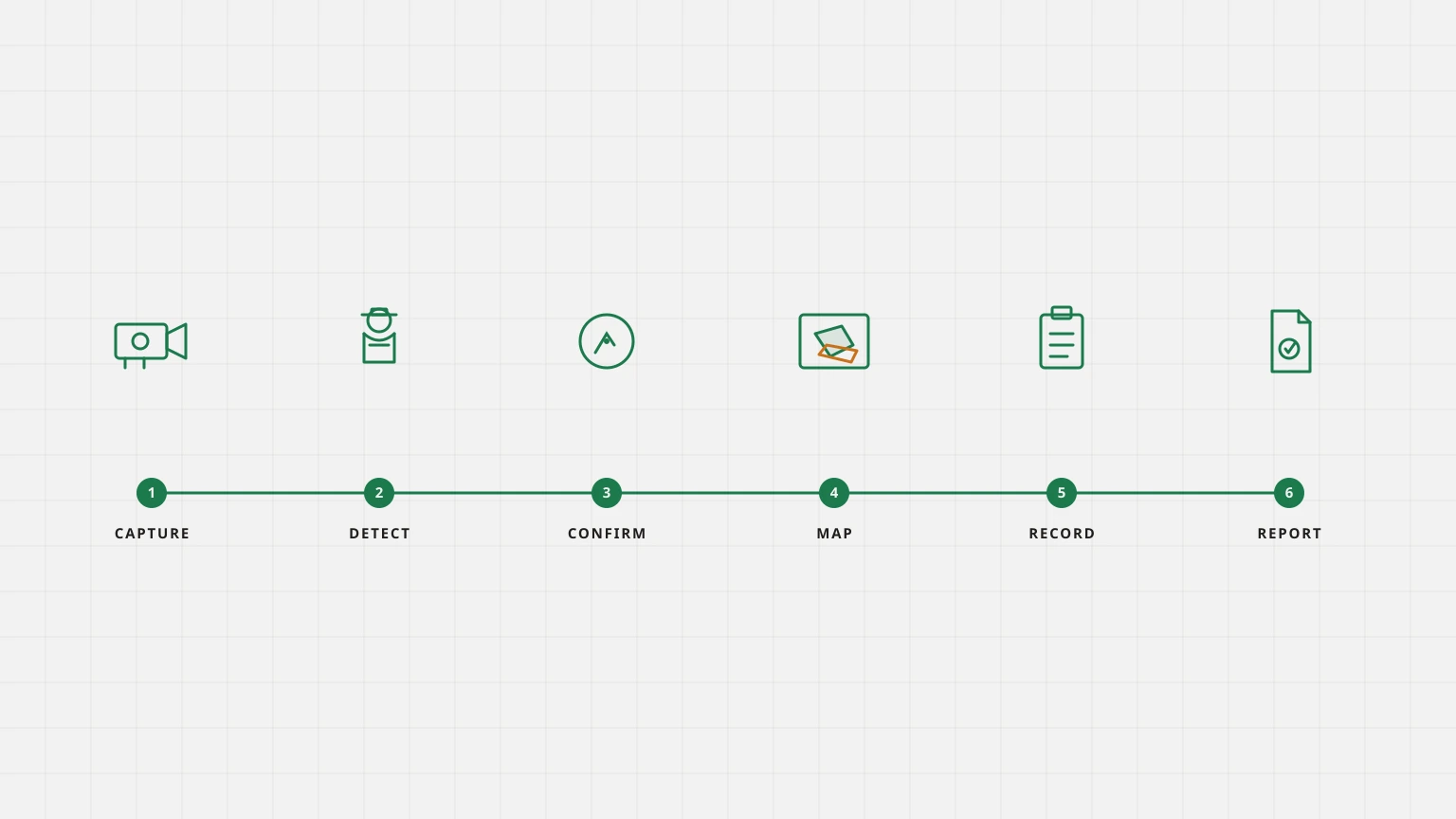
The loop is the same on every oil and gas site we sit on. Capture from the cameras you already run, detect what the lens can name, confirm with a sensor when you have one, then keep a record an accountable person can sign.
- 01 Capture
Existing cameras stream over RTSP or ONVIF into an on-site appliance. There is no rip-and-replace of the estate.
- 02 Detect
Models name what the lens sees, tuned for night IR, heat-haze, dust and unlit remote sites.
- 03 Confirm
Confidence scoring plus the sensor you already run. Human review is a switch you turn on for regulator-bound records. It is off by default.
- 04 Map
The event is tied to a zone, a clock and, where it applies, a pre-filled record.
- 05 Record
Clip, metadata and the sensor bit sit on your network. Raw video stays on site.
- 06 Report
An approver signs anything that leaves. Nothing auto-submits to NUPRC, NMDPRA or NOSDRA.
How it runs on your site
Inference runs on an edge appliance on your OT network. Air-gapped is supported, which is what most OT reviews actually ask for. An optional console can sync events, metadata and consented clips. Raw video stays on the operator network by default, including on thin VSAT links.
Questions operators ask
- Does this work on the CCTV we already run?
- Yes. Existing IP, NVR and ONVIF cameras stream into an on-site appliance. Hikvision, Dahua, Axis and others are already in the field. We do not ask you to replace them.
- Can a confirmed sheen pre-fill a NOSDRA record?
- Yes. The record is pre-filled with clip, GPS and time. An accountable approver still signs it. Nothing is sent to a regulator until that person says so.
- Does footage leave the OT network?
- Not by default. Inference runs on the edge. Only events, metadata and clips you consent to ever sync. Air-gapped is supported.
- How do you keep long-fence false alarms down?
- A PIDS-only trip logs. A PIDS trip plus a person in frame can notify or actuate. Confidence tiers keep the night shift from living in the alarm list.
- Will fire models trip on flare glow?
- They are tuned against flare glow, and corroborated by a flame or LEL detector where those sensors exist. A video-only flag against a live flare stays at a low tier.
- Does ANPR work at dusty loading racks?
- Yes, with models tuned for dust, glare and plate angle. A plate that does not match a booking is a check against the list, not a judgement of the driver.
We cannot tell from camera that a person at a manifold is removing crude, only that they are there when nobody should be. We cannot see a leak underground. We see pooling on the surface, and a pressure drop on SCADA when you give us that tag.
See it on your cameras
Setup in days. A measured 30-day pilot on the feeds you already run.